A privacy-first Cleanfox alternative
If you are weighing a Cleanfox alternative, the sticking point is usually how a free tool pays for itself. Cleanfox does genuinely unsubscribe you, but it is free because its parent company turns the contents of users' inboxes into anonymized market-research data it then sells. ClearMyInbox does the same core job - bulk unsubscribe across Gmail and Outlook - without mining your inbox, and it verifies each sender actually stopped.
Try ClearMyInbox free - bulk unsubscribe in one click, free to start.
Why look for a Cleanfox alternative?
Cleanfox is a capable, well-designed app, and to its credit it discloses how it makes money. The reason people shop around is that the money comes from their inbox. Foxintelligence, the company behind Cleanfox and now part of NielsenIQ, builds anonymized consumer-spending panels from the receipts and marketing mail in users' accounts and sells that data to brands and researchers. If you would rather pay with money than with your purchase history, that is the whole case for switching. Cleanfox is not alone here either - our Unroll.me alternative guide covers the other well-known cleaner with a data-funded business model.
There are two smaller reasons too. Cleanfox is built mobile-first, which is great on a phone but less suited to clearing a large inbox at a desk. And like most cleaners, it gives you no confirmation that a sender honored the unsubscribe - you fire the request and hope. An alternative that runs as a proper web app and proves each opt-out landed closes both gaps.
ClearMyInbox vs Cleanfox at a glance
Both tools really do unsubscribe you. The differences are the data model, the verification step, and the desktop-grade workflow.
| Feature | ClearMyInbox | Cleanfox |
|---|---|---|
| What it does | Bulk unsubscribe, then verify each sender stopped | Bulk unsubscribe and bulk-delete old mail |
| Data model | Never sells or shares inbox data | Parent company builds and sells anonymized purchase-data panels from inboxes |
| Verifies sender stopped | Marks each sender "Confirmed stopped" | No proof the sender stopped |
| Primary platform | Web app for Gmail, Outlook, Yahoo, and any IMAP mailbox | Mobile-first (iOS and Android), plus web |
| Real unsubscribe | Sends List-Unsubscribe opt-outs | Yes, sends opt-out requests |
| Free tier | Free plan, no credit card | Free (funded by data monetization) |
| Email providers | Gmail, Outlook, Yahoo, and any IMAP mailbox | Gmail, Outlook, Yahoo, and others |
| Access model | Read-only OAuth, revoke anytime | OAuth access |
| Scheduled scans | Yes, on paid plans | No |
What makes ClearMyInbox different
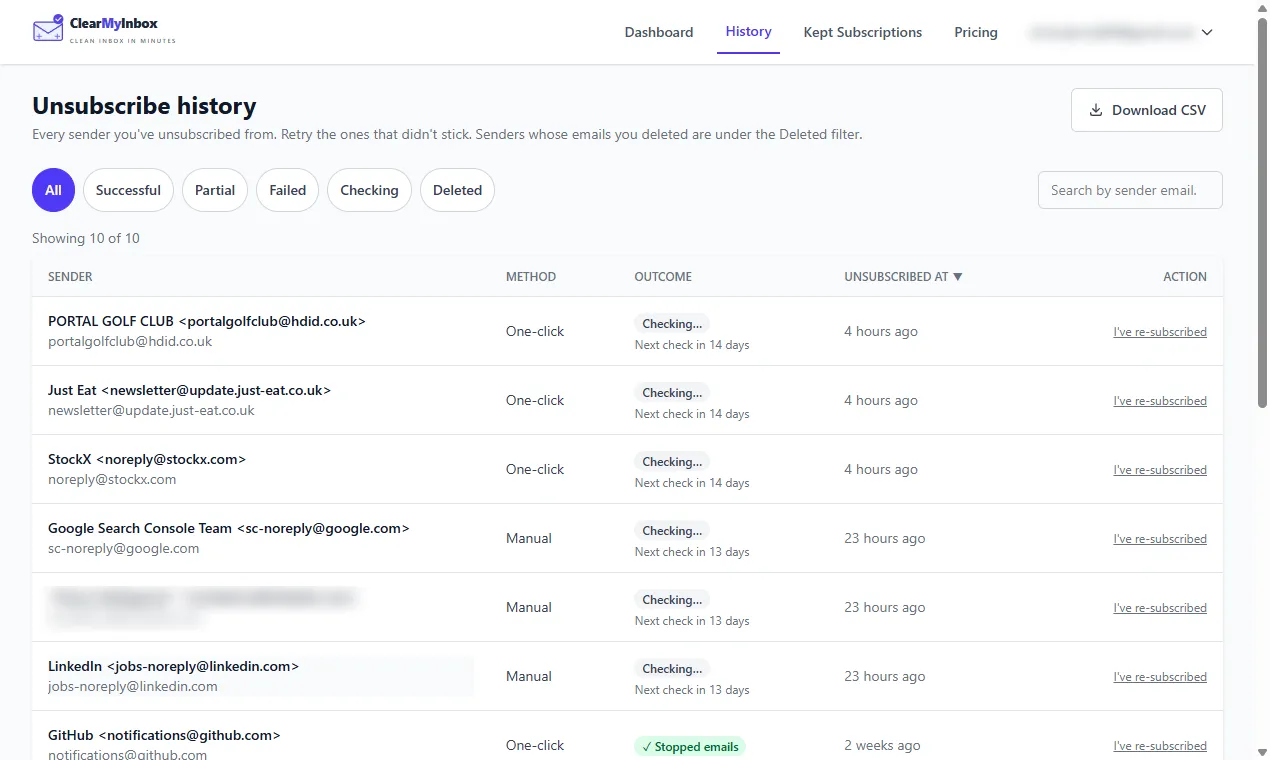
The headline difference is how it is funded: ClearMyInbox charges for paid plans and never sells your data, so there is no incentive to read your inbox for anything other than finding subscriptions. On top of that comes verification. After a bulk unsubscribe, ClearMyInbox keeps watching each sender and marks it Confirmed stopped once the mail actually ends, or flags the ones still emailing so you can act. Most cleaners, Cleanfox included, stop at sending the request.
It also runs read-only on official OAuth you can revoke at any time, and it is built for the desktop job of clearing a cluttered account for good. For the mechanics of doing this at scale, see our Gmail mass unsubscribe guide.
How to switch from Cleanfox to ClearMyInbox
- Revoke Cleanfox's access from your Google or Microsoft security settings so it stops reading your inbox.
- Sign up for ClearMyInbox and connect your mailbox with read-only access - Gmail, Outlook, Yahoo, or any IMAP provider.
- Run a scan - it lists every newsletter, promotional, and notification sender in your inbox.
- Select the senders you want gone, or use Select All, and confirm the bulk unsubscribe.
- Check back in a few days to see which senders are marked Confirmed stopped.
Is Cleanfox still worth using?
If you are comfortable with the data trade and mostly clean your inbox from a phone, Cleanfox does the job and costs nothing. But if you would rather keep your purchase history out of a market-research panel, want proof each unsubscribe worked, and prefer a full web workflow for Gmail and Outlook, ClearMyInbox is the better fit - and you can try it free. If you are still weighing up the wider market, our roundup of the best bulk unsubscribe apps compares every option in one place.
Frequently asked questions
Why look for a Cleanfox alternative?▾
The most common reason is the business model. Cleanfox is free because its parent company, Foxintelligence (now part of NielsenIQ), builds anonymized consumer purchase panels from the receipts and emails in users' inboxes and sells that market-research data. Cleanfox discloses this, but plenty of people would rather use a tool that makes money from subscriptions than from their inbox. The other reasons are that Cleanfox is mobile-app-first and offers no proof that a sender actually stopped after you unsubscribe.
Does ClearMyInbox sell my data like Cleanfox's parent company?▾
No. ClearMyInbox connects through official Google and Microsoft OAuth with read access only, finds subscriptions using the standard List-Unsubscribe header, and never sells, shares, or builds market-research panels from your inbox. It is funded by paid plans, not by your data.
Does Cleanfox actually unsubscribe you?▾
Yes - unlike a digest tool, Cleanfox does send real unsubscribe requests and can bulk-delete old mail. The gaps are that it does not verify the sender stopped, and it is built around a mobile app rather than a full web workflow for Gmail and Outlook.
Does ClearMyInbox verify that senders actually stopped?▾
Yes, and it is the main thing that sets it apart. After a bulk unsubscribe it keeps watching each sender and marks it "Confirmed stopped" once no new mail arrives, or flags the ones that ignore the request so you can escalate. You get proof the opt-out worked, not just a "done" message.
Is ClearMyInbox free?▾
There is a free plan, so you can clean up your inbox before paying anything. Paid plans lift the monthly cap on one-click unsubscribes and add automatic and scheduled scans, sender blocking, and analytics.