Why am I getting emails from emergencyemail.org?
People searching "emergencyemail.org spam" are usually getting weather forecasts and breaking-news alerts from The Emergency Email & Wireless Network, a service Enotem, Inc. has run since 1999. Its own privacy policy says it takes addresses from "co-registration partners" and contacts its lists about sponsors, which explains mail you never asked for. It is legitimate but aggressive, not a scam.
Try ClearMyInbox free - bulk unsubscribe in one click, free to start.
Who runs emergencyemail.org?
The footer of every page on the site, read on 13 November 2026, says "Portions Copyright ©1999-2026 The Emergency Email & Wireless Network Enotem, Inc." The About page says the network was "Founded in 1999 by Skip Tamargo", that former FCC Commissioner Henry Rivera "joined shortly thereafter", and that it began by sending "the first critical & emergency news to evacuees of hurricane Floyd". It describes itself as "the 3rd largest breaking news, and National Weather Service EMWIN content provider on the Internet" and says it has "sent billions of messages by email and to wireless devices". The Terms of Use are governed by "the laws of the State of Florida"; no street address appears on any page we read.
What it sends is in the site's menu: Breaking News, Product News, Politics News, Terrorism & Threat News, Health News, Public Services, recalls, airport delays, weather radar, and a morning weather forecast. The partners page lists emergency management offices and fire departments that link to the service, and adds a line that matters for your inbox: "Look for our sponsored links on CNN, Fox News, CBS News, NBC News and ABC News websites." Sponsored placements are how a free alert service pays for itself, and sponsors are the reason the mail is not only weather.
How did emergencyemail.org get my email address?
The sign-up itself is tiny. Choosing a state and county on the site leads to a form with two fields, "Email Address" and "Zip / Postal Code", and a "Submit Registration" button. Nothing else is asked, which is why the privacy page carries a banner reading "PLEASE NOTE: We DO NOT have information on or collect your: name, address, phone number, or know your personal identity." The Terms add that "by providing your email address, you agree to these terms and conditions". So one route is that you, or someone with your address, typed it into that form after a storm warning on a county website.
The other route is the one that answers "I never signed up". The privacy policy, effective 31 December 2022, says: "We collect information about you when you subscribe to our services including from co-registration partners". Co-registration is the checkbox on another company's form that signs you up to a second company's list at the same time; our guide to pre-checked opt-in boxes shows how often that box is ticked for you. The same policy says personal data is gathered "directly or through our sponsors", that "We may from time contact our lists to offer other services or to identify our sponsors", and that under California law "we may Sell and Share certain online identifiers for the purposes of online advertising and analytics". A "Do Not Sell or Share My Personal Information" link is in the footer.
How do I unsubscribe from emergencyemail.org emails?
The sender has its own unsubscribe page, linked as "Unsubscribe" in the navigation and footer of every page. It is headed "UNSUBSCRIBE or make changes to your Email Profile" and asks you to "Enter the Email Address you signed up with":
- Go to emergencyemail.org and click Unsubscribe in the footer (the page is upd.asp).
- Enter the exact address the alerts arrive at. The profile is keyed on the address alone, because the service holds no name.
- Choose to unsubscribe entirely or to change which alerts you get, and submit.
Two things the sender's pages do not tell you: how long removal takes, and what happens to sponsor mail after you leave. If your complaint is only the daily forecast, there is a narrower switch. A separate page headed "Only Click This Button if you want to permanently unsubscribe to the MORNING Weather FORECAST" turns off that one list and says "Your Severe Weather and other alerts will not be affected"; the morning forecast is also the list the site notes is "being provided FREE to our subscribers at this time". The footer link in the email itself is the same route from a phone, so there is no separate mobile procedure.
Is it safe to click the unsubscribe link in an emergencyemail.org email?
For a genuine one, yes: the sender publishes its own unsubscribe page and the link in a real email leads there or to its mailing provider. The risk with this sender is imitation. An email that says severe weather or a police incident is affecting your area and asks you to confirm your location is a template phishers copy, and the real service never needs your name or phone number. Check that the link lands on emergencyemail.org before you click; if it goes elsewhere, run it through our unsubscribe link safety checker, and when in doubt verify any emergency through your local authority, not the email.
What if the emails keep coming?
Co-registration lists are re-fed. If you unsubscribe and the alerts return weeks later, the likeliest cause is a partner form submitting your address again, which the sender treats as a new subscription. Unsubscribe once more, send a privacy request to the address the policy gives (support at emergencyemail.org), then block the sender so a third round never reaches you. Pick the guide for your mailbox: block a sender in Gmail, block a sender in Outlook, block a sender in Yahoo Mail or block a sender in the iPhone Mail app. Block the domain, not one address, because alerts and sponsor mail can come from different mailboxes. The site also has a "SPAM Complaint" page for reporting abuse that uses its name; it asks for the date, the sender address and the full headers.
What ClearMyInbox does with a sender like emergencyemail.org
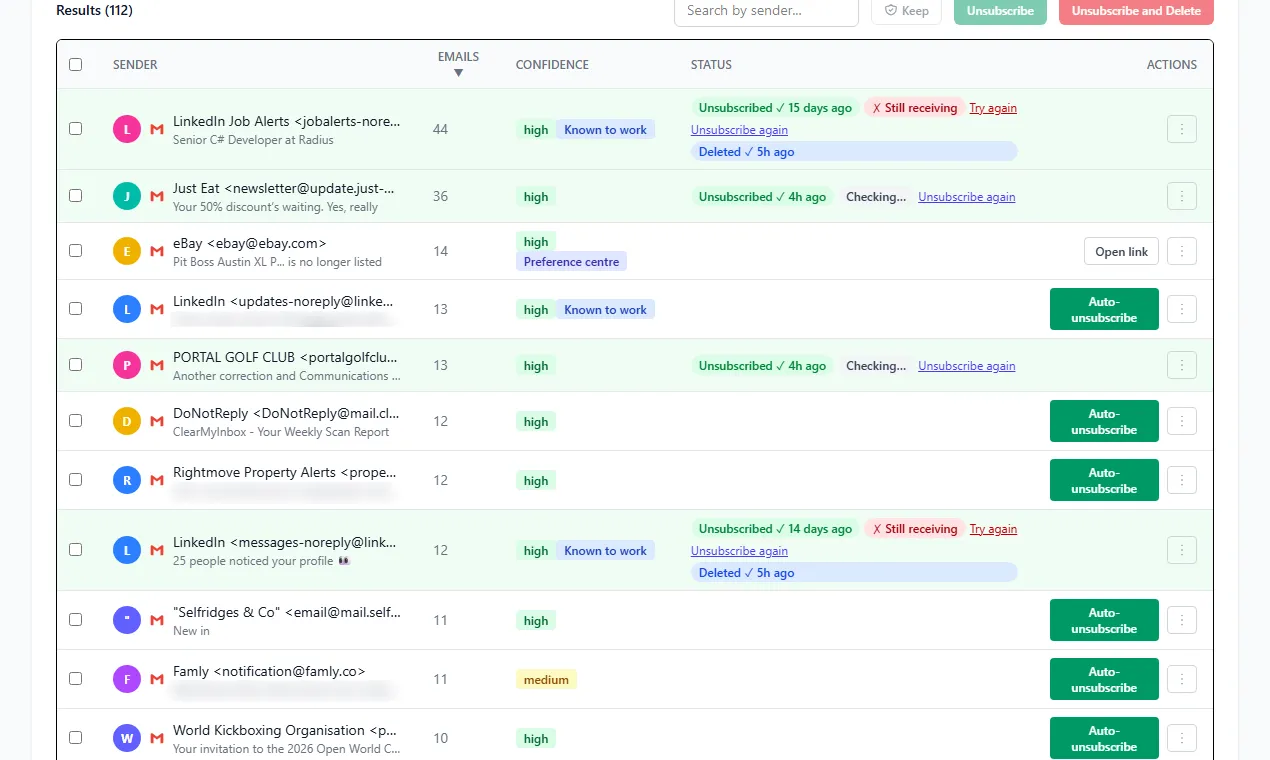
A sender that admits co-registration is the kind that comes back, so the useful tool is one that checks. ClearMyInbox connects to your Gmail, Outlook, Yahoo or any IMAP mailbox, finds every sender with an unsubscribe link, and sends the requests for the ones you pick in one go. It then re-checks each sender and labels it Confirmed stopped or flags it as still emailing. If emergencyemail.org is flagged a month later, you know the list was re-fed and blocking is the answer, without having to watch the inbox yourself.
Frequently asked questions
Is emergencyemail.org legit?▾
It is a real service with a history going back to 1999, a named company behind it, its own unsubscribe page and emergency-management agencies linking to it. Legit does not mean quiet: its policy allows sponsor mailings and co-registration sign-ups, which is where most complaints come from.
Is emergencyemail.org a scam?▾
Nothing on its own pages, and no regulator record we could cite, supports calling it one. The service is free, asks for nothing but an email and a zip code, and documents how to leave. Scam emails that borrow its name exist, which is why checking the link's destination matters.
Is emergencyemail.org a government alert service?▾
No. It is a private company that, by its own description, redistributes National Weather Service content and news. Official alerts come from your local emergency management office and other government channels; the partners page shows several of those offices linking to this service, not running it.
Why do people on Reddit call emergencyemail.org spam?▾
People on Reddit report receiving the alerts without remembering a sign-up, which the co-registration clause in the privacy policy explains. Those are reports, not findings; the fix in every case is the unsubscribe page above, then a block if it refills.